
I was fortunate to join Forbes as a reporter at the end of 1999, a few years after its online news team had exposed New Republic fabulist Stephen Glass, whose made-up stories would then be emulated by New York Times reporter Jayson Blair. Of course, I wanted to be a novelist and playwright and saw journalism as a step towards those goals. It hurt to see Stephen Glass get a book deal for his roman à clef novel while I couldn’t even get an agent.
But Forbes was much more than a day job for me. I visited Nigeria and Berlin to report stories. I worked with important figures in contemporary journalism like my mentors Bob Lenzner, Tom Easton and Neil Weinberg. I worked for great editors like Bill Baldwin, Dennis Kneale, Stewart Pinkerton, Larry Light, Larry Reibstein and Tom Post. I got to work directly with Steve Forbes and even to argue with him on television. I made some of my most enduring friendships there and I should just stop name dropping because it’s either alienating to some readers or I’m going to leave some important people out.
I joined as a fact checker, which was really the backbone of the enterprise back then. As I recall, only The New Yorker, Forbes and Mother Jones had strong enough fact checking that writers from one of those publications could use articles from the two others as “checkable” sources. Despite the ideological differences between the three organizations, they each practiced “adversarial” checking, where the work of senior writers and editors is skeptically questioned, point by point, in an effort to prevent mistakes. We still once misspelled “America” on a cover, though. No system is perfect in a world of imperfect people. What worked was the commitment to truth, quality and to our readers.
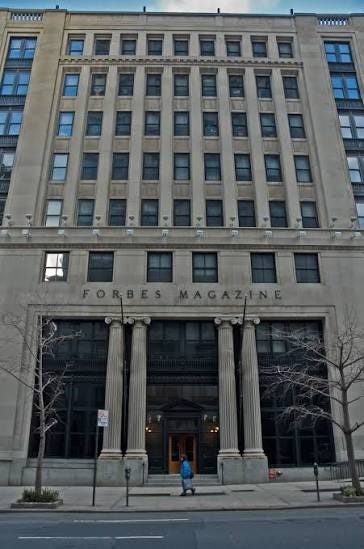
At Forbes you had to accept that successful business people were heroes, but you didn’t have to flatter them. You could work to keep them honest, if only to defend the whole system by demonstrating to capitalism’s critics that we can and will police our own. You can do a lot of impactful journalism that way.
I will always be proud to have played a role in making sure that the heirs of Germany’s Holocaust victims were ultimately paid for the life insurance taken out by people who were kidnapped and murdered by Nazis. I remember interviewing a board member of one of those insurance companies who said to me, “Frankly, I find it hard to get excited about insurance policies that are 60 years old.” When I put the quote in the story I co-wrote with Lenzner, the board member called our magazine editor and I, just under two years into the job, was terrified I would be squashed like a bug. “I was taken out of context,” the board member insisted. To my surprise and without calling on me to defend myself or involving me in any way, Bill Baldwin asked to the man, “What context could possibly explain this?” The quote ran. Weeks later, people who had been waiting decades for payments called to tell me the checks had arrived.
Last week, I read in The New York Times that Randall Lane, the now former Chief Content Officer at Forbes had accepted a $6 million gift from Shook Research, a company that had partnered with Forbes to create a list of influential wealth advisors. Lane hadn’t disclosed what he considered a “gift” from the firm’s founder, made after the sale of his company. The buyer of Shook Research noticed the transfer and called it to the attention of Forbes management. It’s a sign that Forbes has very different values than it used to.
I know Randall socially. I have no axe to grind, though I’ll admit that I did write him, once or twice, trying to get back into the fold and he never answered. I do miss journalism, I don’t think there’s any secret there. Randall got the top job in a roundabout way. He worked at Forbes, left and started his own magazine called Trader. I remember a friend in PR who called me frantically when copies of Trader started showing up in the office mailboxes of investment professionals at Legg Mason. The magazine featured a notorious recurring column called “Trader Dater” where hot mostly Eastern European women told you how much you’d have to earn to get the upward view from between their Louboutins.
Hiring a former employee who had gone away to do something entrepreneurial is a bit of a Forbes tradition. Prior to Randall, Forbes had done the same thing with Lewis Dvorkin, who had worked for Forbes, left to run news at AOL and then founded a company called True/Slant, which Forbes invested in. True/Slant became the backbone of Forbes’ online publishing systems and led to the rise of its contributor network, where the vast majority of its online writing came from people who were not Forbes employees but who had interests and expertise in everything from investments to video games, Hollywood, music, cars, healthcare and, well, you name it.
Dvorkin thrived in an era where online publishers could grab eyeballs by flooding the web with branded articles. Each piece was its own homepage and if you published enough of them, a few would go viral and generate massive ad revenue. To produce at scale, he had to pivot towards a model like the old Huffington Post where many people contribute, not to make a living as writers but to build personal brands or to advertise their own businesses.
When Lane came in the “flood the Internet” model was on the way out as ad rates for page views plummeted, for reasons it’s not worth exploring here. Lane went back to the Forbes cash cow of lists but combined it with the growing business model of events and summits that some people call “live journalism,” but that I will not because the term makes me want to puke. Lane specialized in “30 Under 30” lists, innovator lists and power lists, all tied to events that people would pay to sponsor and attend with the hopes of making those lists themselves. It’s a racket, but not so different from the Aspen Ideas Festival, TED talks or the World Economic Forum Annual meeting. Also, everybody’s doing it.
One cool story I got to do when I was at Forbes, alongside the excellent Jonathan Fahey, was to compete in the Alcan 5000 road rally from Seattle to Yellowknife and ending in Jasper. It was a cool project for the year 2000 because we wrote online diary entries along the way and then a big magazine feature when we got back. We also placed fourth in our division, less from our skills as rally drivers than because of the quality of our car, which was a turbocharged, armor plated, Volvo sportwagon that took off like a Mustang and handled like a Porsche.
The reason I’m digressing into this memory of a fun but long forgotten feature I worked on is that Bill Baldwin, the same editor who defended my reporting when the insurance company board member called to complain, insisted that Forbes would pay Volvo for the car, including the alterations that made it such a great rally vehicle. Bill knew that the car would feature prominently in our story and that if we did well in the rally, the car, not its inexperienced competition drivers, would deserve a lot of the credit. He would let us drive the car, but it could not be a gift. It had to be paid for. Along those lines, if we went out to meals or events with sources, we paid with our corporate American Express cards and then filed the expenses for reimbursement. We were not to let sources pay, for obvious reasons. We were not supposed to take gifts from people in the business community, even if we did not write about them. Again, this is for pretty obvious reasons.
I don’t know why the Shook founder gave Randall Lane $6 million. Lane says they were friends and that it was a gift of appreciation for advice he gave the Shook founder over the years. I recall a much smaller token moment in my career, when I was editor of “Intelligent Investing with Steve Forbes,” a personal finance web project that, among other things, published articles and commentaries written by people from the investment community. A municipal bond manager who wrote a few pieces for me called very excitedly to tell me that he had raised many millions in assets based on a piece he had written for me and that I had edited. He said he wished he could show some appreciation. I told him that aside from his nice phone call and thank you that he could not and that was the end of it. I guess that’s not how the game is played anymore.
To be very sure, as one of my old editors used to say, it wasn’t illegal for Lane to take the money. The payor and payee are both private individuals. One was the founder of a private business that he sold, the other an employee of a private business. There’s no “public” money involved and if there was any sort of quid pro quo it hasn’t been proven or even too pointedly alleged. Lane lost his job but so far as anyone can tell, is keeping the millions. It’s a classic “appearance of impropriety” and I guess we know that $6 million is just too much to turn down for the sake of appearances.
What’s frustrating is how rare a job Lane held and how so many people (myself included, but I could name fifty great people without pausing for breath) could excel at. Moreover, each of us would love to do it and would value it more than even a two comma check from an old pal.
But, then again, I could say the same about writing for New York magazine. New York just parted ways with Ross Barkan, a journalist, essayist and novelist who has had an enviable career and notoriety but who has been outed as a plagiarist. It is frustrating to see people squander posts at New York that so many of us would enjoy and, yes, excel at, when we would not even think to plagiarize because we love the lively art of writing and would no sooner cheat ourselves as we would cheat at solitaire.
In a very competitive job market, where the dream jobs are rare, it is perplexing and infuriating to see so many roles taken up by people who just don’t respect or appreciate what they have. They sell out. They lie. They cheat. But they succeed.
When I was young, Bill Clinton won the presidency campaigning to represent people who “worked hard and played by the rules” but who were left behind by the economy. We don’t hear much about that anymore and our current President, once a friend of Bill’s, believes that rule-abiding is largely for suckers. So, here we are. I’m not sure where we’re headed or even how I, personally, am supposed to get there.
Great post. Exactly how I feel about my time at Forbes, as a contributor and as the grateful Loeb finalist for the first Forbes magazine stories I wrote with the great editor Janet Novack. It really is a shame and you captured my sentiments exactly.
Excellent writing, and you got straight to the point of it all. Thank you.