
Sparked by Salomon Grimberg’s tight and revealing book, Jacqueline Lamba: The Forgotten Surrealist, I’ve found myself on a mission to learn more about Mexican artists from the early 20th century who helped build the bedrock of modern art in America, a story that Natasha Gural has told, in response to the curatorial efforts of Barbara Haskell at the Whitney Museum of American Art.
I am always on the look-out for forgotten surrealists and once you start peeking through the foliage of art and culture, you’ll find them everywhere because surrealism is a natural response to the absurdity of human life, just based on how we treat each other, never mind nature’s malign indifference to our suffering. If you’re keen to see it, you’ll find surrealism in all cultures and all epochs. It shows up in democracies and dictatorships, in market economies and under the watch of central planners. It’s so easy to find surrealists that some artists don’t welcome the label.
Jacqueline Lamba is one of them. Her first husband was André Breton, considered one of the founders of modern surrealism, along with Marcel Duchamp and Alfred Jarry. Throughout her life and art-making career, Lamba embraced and rejected the brand. She socialized with surrealists, she married a surrealist, she performed burlesque in surrealist venues and in her art and lovemaking comported herself as a counter-cultural force, but in a lifelong creative career, she clearly transcended the label.
Lamba and Breton visited Mexico and there met Frida Kahlo and Diego Rivera. Rivera was a left-wing muralist, a supporter of Leon Trotsky and, along with Frida, active in socialist politics in Mexico. Kahlo was also a painter, known for her portraiture and her own expressions of solidarity with Mexico’s working class. She was also a style iconoclast who used the Tehuana dress to both celebrate traditional pre-Columbian Mexican culture and to cover injuries from chdilhood polio and a nearly fatal trolley accident.
Breton claimed allegiance to the anything-goes sexual mores of the Marquis de Sade but was often jealous of Lamba, whose trapeze-honed body and penchant for public nudity attracted much attention. Rivera and Kahlo also both had affairs, though both were also dramatically jealous. Rivera didn’t mind Kahlo’s dalliances with women but had credibly threatened tommurder a few men, Lamba and Kahlo explored some mutual affection, as detailed by Grimberg, but what stuck with me is that it was Breton who declared that both Lamba and Kahlo were surrealists. Kahlo’s sardonic response was that she did not know she was a surrealist until Breton had told her she was.
Kahlo wasn’t the only Mexican woman painter to have surrealism thrust upon her. Maria Izquierdo, the first Mexican woman to have a solo show in the United States, also took on the surrealist brand, though she had no connection to the movement. This context came from Frances Flynn Paine, an art advisor to the Rockefeller Family who was born in Texas and raised in New Mexico. Paine made the popularization of Mexican art in the U.S. her life’s work. She introduced Kahlo and Rivera to the Rockefellers and organized solo and group shows for Mexican artists, often with support from the Rockefeller family, who wanted friendly relations with Mexico’s government to avoid having their oil fields confiscated by the state.
Surely, what we might recognize as being akin to Europe’s surrealism was part of Mexico’s art scene and it is in the works of Izquierdo, Kahlo, Rivera and Leonora Carrington, to name a few. It’s also prevalent in folk art. Its contemporary application had the name Stridentism and it mixed elements of cubism, Dadaism and surrealism in ways that resemle afro-futurism.
Surrealism, as a natural reaction to life on Earth, shows up in all cultures, under many names and guises. About as ubiquitous in the art world are men enthusiastic to tell women what kind of art they’re making. Because European surrealism and Dadaism (and futurism) were political and social movements, too, there was a natural tendency to want to swell the numbers of initiates and supporters. Lamba’s association was by both marriage and the content of her work and Breton was eager to have Kahlo and Rivera in the club as well.
Women in Paris, including Lamba and Kiki Man Ray (also known as Kiki de Montparnasse) were pulled into the scene by their participation in cabaret and burlesque performances and also by the desire and needs that male painters, sculptors and photographers had for often nude models. Sometimes the modeling and performance overshadowed the art work, at least for a time. Kahlo’s artistic reputation eclipsed her status as a fashion icon and certainly as wife to Rivera. She’s an exception as interest in her heart continues to grow.
Lamba divorced Breton, but remained on friendly terms with him. She lived and worked until 1993, developing her art and style over decades. There’s surrealism in her work, as there is in Kahlo’s, it’s not just part of a movement.
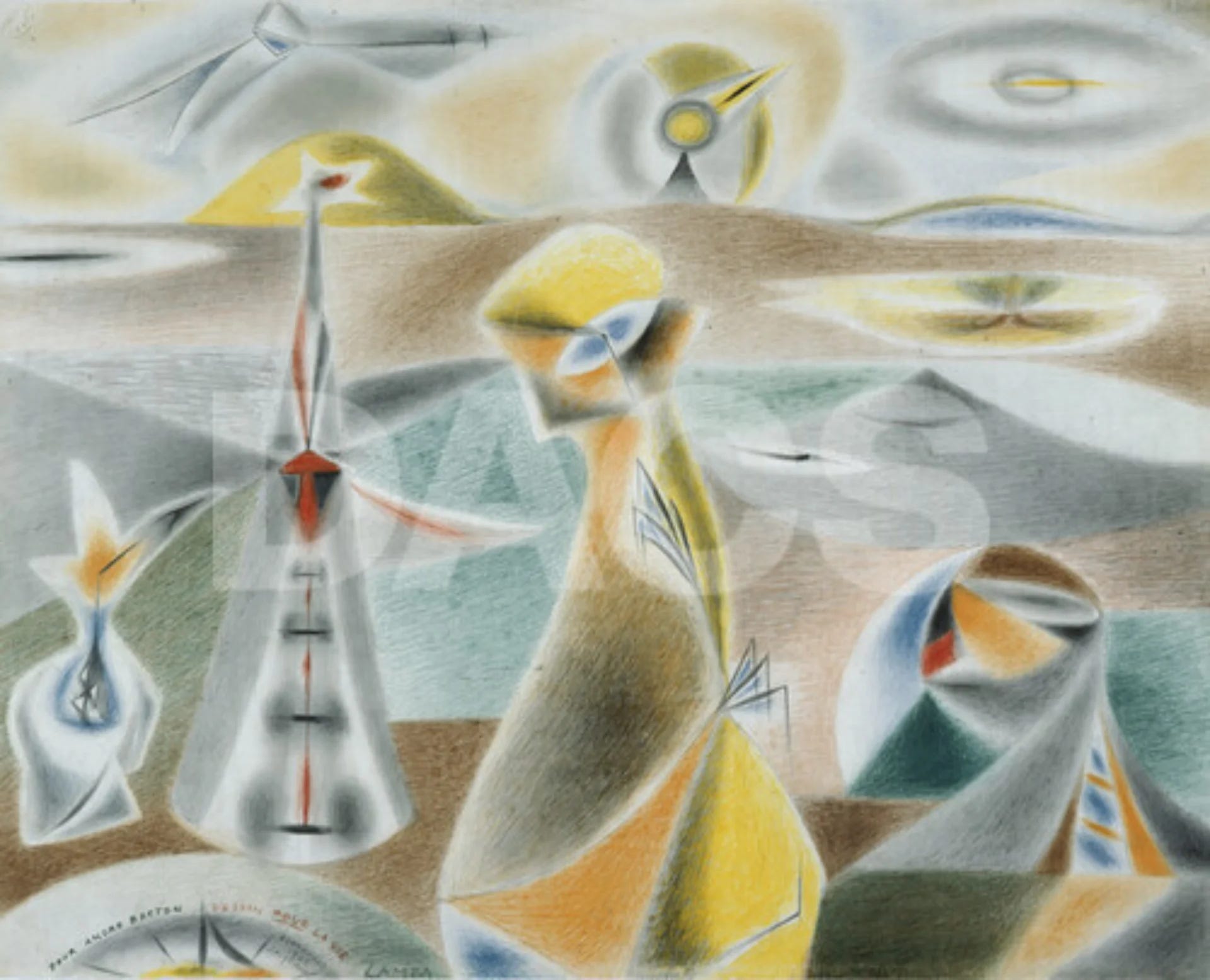
A lot of early 20th century surrealism was an attempt to mine the unconscious mind, but Kahlo says she never intended this with her work. “I never painted my dreams, I painted my own reality,” she said.
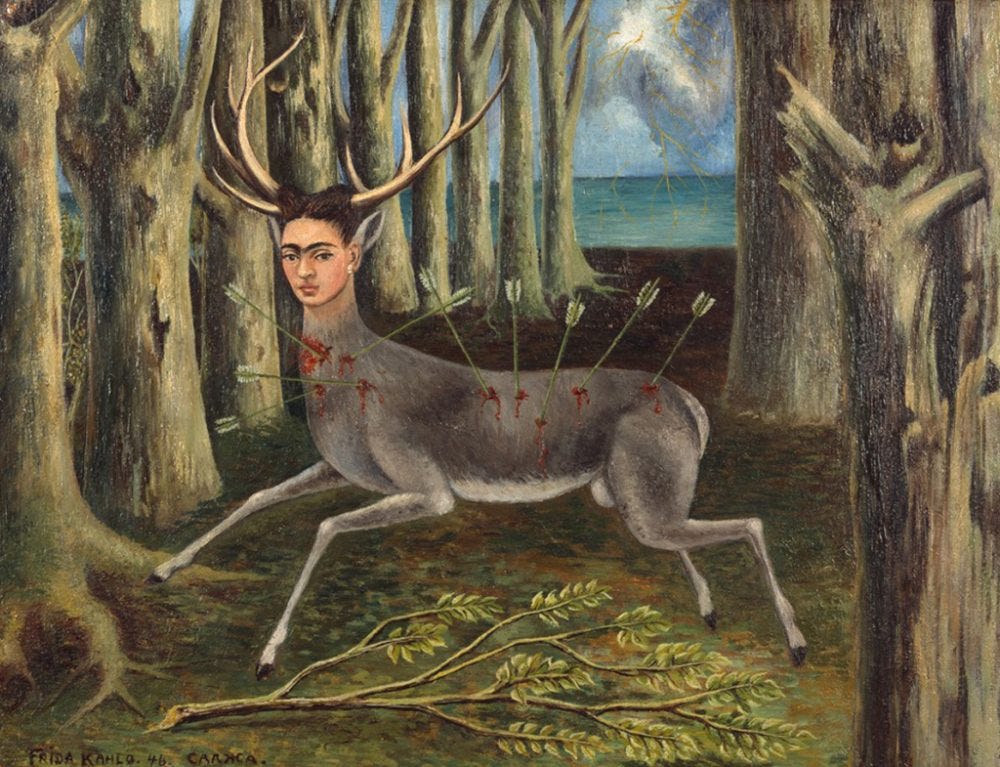
I sympathize with Kahlo’s outlook, and Grimberg’s book suggests that Lamba agreed with her that surrealism isn’t the stuff of our inner lives but of the world around us. What makes these images so moving is that they sacrifice literal truth for something that resonates with all six of our senses.